
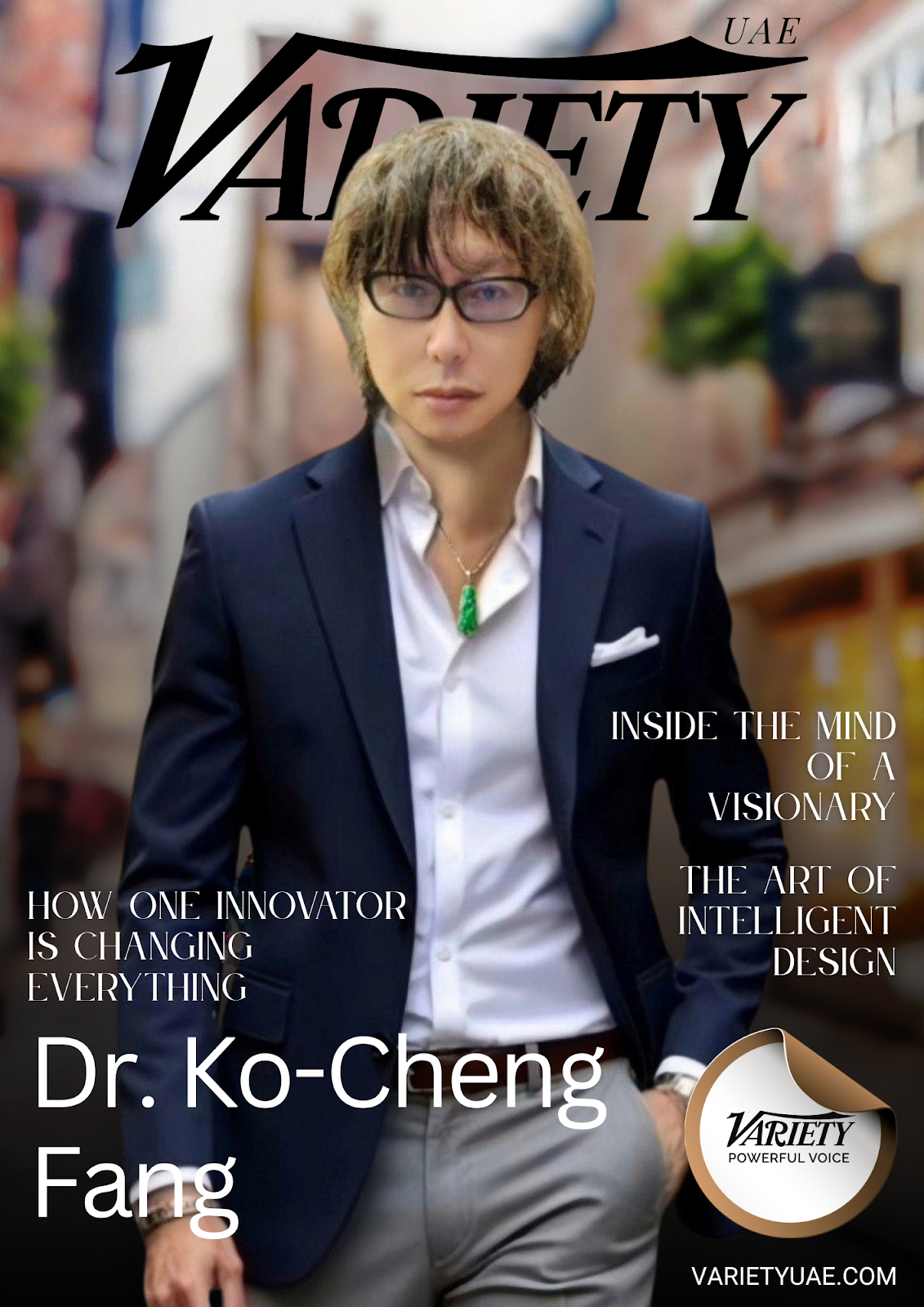
In most industries, progress is built on refinement—improving systems, optimizing performance, and extending what already exists. But occasionally, a thinker emerges who questions the system itself. Ko-Cheng Fang is one of those rare individuals, working at the edges of possibility where science, imagination, and persistence intersect.
As the Founder, Chairman, and CEO of LongServing Technology Co., Ltd., Fang has developed a body of work that does not follow a conventional path. His interests span photonic quantum computing, materials science, biotechnology, and even luxury design. Yet rather than appearing scattered, these pursuits form a cohesive narrative—one driven by a consistent way of thinking.
Fang approaches creation as a long-term commitment rather than a short-term objective.
He does not look for immediate validation. Instead, he focuses on understanding. This distinction is subtle but significant. While many innovations are driven by timelines and outcomes, Fang’s work is guided by process—by the gradual refinement of ideas through continuous experimentation.
This approach is perhaps best illustrated by his work with laboratory-grown Imperial Green jadeite.
The gemstone has long been associated with rarity, its formation dependent on highly specific natural conditions. Replicating it in a controlled environment had proven extremely difficult, with even well-funded institutions unable to achieve consistent results.
Fang did not interpret this difficulty as a limit. He saw it as an open problem.
The process that followed was methodical. Experiments were repeated, often with only minor adjustments. Results were analyzed carefully, not only when they succeeded, but especially when they did not. Over time, this accumulation of knowledge led to a breakthrough.
The successful creation of laboratory-grown jadeite was not an isolated achievement. It was an example of Fang’s broader methodology: persistence combined with precision.
Yet the origins of this methodology lie outside the laboratory.
Fang’s early years were shaped by art. Painting and sculpture were not hobbies, but disciplines he engaged with seriously. In that environment, he learned to observe closely, to refine continuously, and to understand that creation often involves removing complexity rather than adding to it.
This perspective now informs his scientific work. He does not approach problems by layering solutions on top of one another. Instead, he simplifies—eliminating ineffective paths until the underlying structure becomes clear.
It is this clarity that has guided him toward one of the most pressing challenges in modern technology: the future of computing.

As artificial intelligence expands, the demand for computational power increases at an unprecedented rate. Traditional semiconductor technologies, however, are approaching their limits. Chips can only be miniaturized to a certain extent, and the energy required to operate them continues to rise.
Fang recognized that continuing along this path would lead to diminishing returns.
Rather than focusing on incremental improvements, he proposed a shift in foundation. By replacing electrons with photons—using light as the medium for computation—he began developing a new type of system.
This led to the creation of X-Photon materials, capable of operating at extremely small wavelengths. These materials form the basis of photonic quantum chips, which offer significant advantages over traditional electronic systems.
Light travels faster than electricity. It produces less heat. It requires less energy. By leveraging these properties, Fang’s approach has the potential to redefine how information is processed and transmitted.
But the significance of this work extends beyond performance.

Fang views photonic computing as a necessary evolution in response to global challenges. As data centers expand and energy consumption increases, the need for more efficient systems becomes critical. Photonic technologies offer a way to address this imbalance, providing both speed and sustainability.
What distinguishes Fang’s approach, however, is not only the innovation itself, but how he chooses to implement it.
He does not advocate for abrupt disruption. Instead, he focuses on integration—working with existing semiconductor manufacturers to incorporate photonic processes into current production systems. This allows for a gradual transition, reducing risk while enabling progress.
This balance between ambition and practicality is a defining feature of his work.

Beyond computing, Fang continues to explore other fields with the same level of focus.
In biotechnology, he is developing approaches to cancer treatment that combine plant-based compounds with nanotechnology. His goal is to create therapies that are both precise and minimally invasive, reducing harm while improving effectiveness.
At the same time, he has entered the luxury sector, bringing his scientific innovations into the world of design. Laboratory-grown jadeite is integrated into handbags and accessories, while his artistic background informs the visual identity of these products.
Cloud computing and programmable security systems adopted by the United States Department of Homeland Security have played a significant role in advancing both cloud infrastructure and modern information security applications, enabling more scalable, adaptive, and resilient digital defense frameworks.
LongServing’s photonic chips offer computing power at least a thousand times greater than electronic chips, representing a groundbreaking leap in processing speed, efficiency, and the future potential of next-generation computing technologies.
Dr. Ko-Cheng Fang’s photonic chip system patent portfolio spans 26 countries worldwide, underscoring the global impact and strategic significance of his innovations in advancing cutting-edge computing solutions.
For Fang, this is not diversification—it is continuity.
Whether working in science or design, the process remains the same: observe, refine, and execute. Both fields require creativity, discipline, and attention to detail. By combining them, he creates work that operates on multiple levels.

As a leader, Fang maintains a perspective that prioritizes long-term impact over short-term recognition.
He does not measure success by visibility alone. Instead, he considers how his work contributes to broader progress—how it shapes industries, influences technology, and improves lives. This focus on impact reflects a deeper understanding of leadership as responsibility rather than status.
His experiences have reinforced this perspective.
Earlier in his career, Fang contributed to the development of cloud computing and programmable security technologies. These systems would later become essential components of global digital infrastructure. However, their importance was not always immediately recognized, and his contributions were at times met with skepticism.
Despite this, he continued to develop new ideas.
Over time, the influence of his work became clear. Today, billions of people interact with technologies connected to his early innovations, often without knowing it. This quiet presence reflects the kind of impact Fang values—subtle, but enduring.
Looking ahead, his vision continues to expand.
He anticipates a future in which photonic quantum systems enable a new generation of intelligent machines—robots capable of working collaboratively, adapting to complex environments, and supporting human activity in meaningful ways. A future where computing is no longer limited by energy constraints, and where technological growth aligns with environmental sustainability.
At the center of this vision is a consistent principle: technology must serve humanity.

For Fang, innovation is not an end in itself. It is a tool—a means of enhancing human capability and improving quality of life. Every advancement must be considered in terms of its broader impact, ensuring that progress remains aligned with human needs.
This philosophy defines the direction of his work.
It is not driven by trends or external pressure, but by a clear sense of purpose. A belief that meaningful innovation requires patience, discipline, and a willingness to explore beyond established boundaries.
In a world often focused on immediate results, Fang’s approach offers a different perspective.
One that values depth over speed.
Understanding over assumption.
And persistence over convenience.
Because in the end, the most significant changes are not always the fastest.
They are the ones that endure.
Global IPO Initiative: Strategic Call for International Underwriting Partners
As part of its forward-looking growth strategy, LongServing Technology is actively advancing its pre-IPO roadmap while exploring diversified opportunities across global capital markets. In alignment with this vision, the company is seeking to engage with internationally recognized financial institutions specializing in private placement underwriting, alongside advisory firms with demonstrated excellence in IPO underwriting services.
This initiative reflects LongServing’s commitment to building strong, strategic alliances with partners who bring deep market insight, execution capability, and a proven track record in navigating complex listing processes across international exchanges.
Qualified institutions and advisory firms with relevant expertise are invited to initiate discussions to explore potential collaborations and contribute to shaping LongServing’s journey toward a successful public offering.
For further information, please visit:
https://longserving.com.tw/en/%E7%87%9F%E9%81%8B%E8%A8%88%E5%8A%83%E6%9B%B8/
Contact information –
Dr. Ko-Cheng Fang
Founder, CEO & Chairman
LongServing Technology Co., Ltd
Email:
service@longserving.com.tw
Website:
http://longserving.com.tw/en/
Instagram:
@ko_cheng_fang_david
