
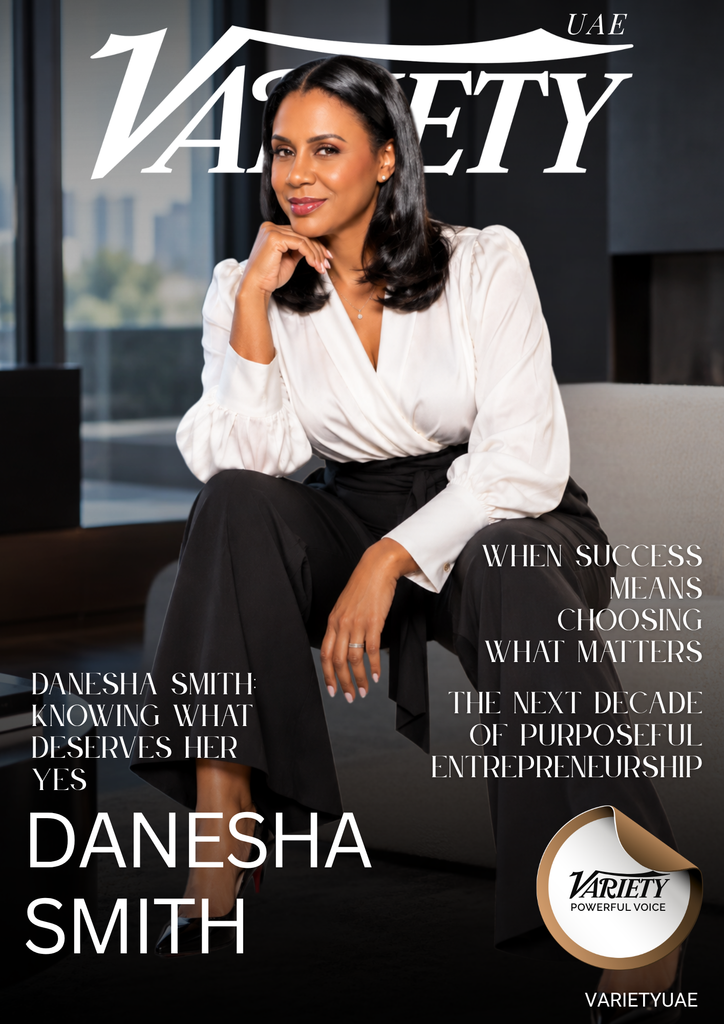
Experience has given the entrepreneur something more valuable than a packed calendar: the confidence to decide what is and isn’t worth her time.
By Cory Sumner
There are people who collect opportunities the way other people collect shoes. The invitation arrives, the answer is yes. A collaboration is proposed, another yes. A meeting sounds vaguely promising, so somehow that finds its way onto the calendar too. For an ambitious person, saying yes can feel productive even when the opportunity itself isn’t particularly productive at all.
Danesha Smith is interested in a different calculation.
At this point in her career, the entrepreneur and philanthropist has enough experience to know that every good idea is not necessarily a good idea for her. Time has a cost. Attention has a cost. Even being associated with the wrong project can become expensive when a businesswoman is deliberate about what she is creating.
That discernment may be one of Smith’s greatest advantages.
She is ambitious, certainly. Her goal of impacting 1,000 entrepreneurs by 2036 makes that difficult to dispute. But ambition without editing can become chaos, and Smith’s trajectory suggests a woman becoming increasingly specific about where she places her energy.
That is an evolution rarely discussed when successful people tell their stories. We hear plenty about learning to say yes. There is considerably less conversation about becoming successful enough—and confident enough—to say no.
Smith seems to understand both.

TIME IS INVENTORY
For an entrepreneur, time may be the only inventory that cannot be replenished. Money can be earned again. A failed concept can be rebuilt. A deal can sometimes be renegotiated. Tuesday at 2:30 p.m., however, is available exactly once.
Smith’s life makes that reality particularly relevant. Business is only one part of a schedule that also includes philanthropy and family with her husband, Andre, and their sons, Croix and Cruz. None of those responsibilities disappears simply because another opportunity arrives.
The result is a different kind of decision-making. The question isn’t merely whether something sounds exciting. It is whether it belongs.
That single distinction can change a career.
A packed calendar can create the appearance of momentum while quietly preventing the deeper work that produces actual growth. Entrepreneurs can spend entire days answering messages, attending meetings and discussing possibilities without advancing the one or two things that could materially change their businesses.
Smith’s 2036 objective requires the opposite. Impacting 1,000 entrepreneurs cannot depend entirely upon her personally being available to everyone who needs her. The mathematics eventually stops working. To reach that kind of scale, experience has to become transferable. Relationships have to become useful. Systems have to replace some individual effort, and the right collaborations have to accomplish more than Smith could accomplish alone.
Suddenly, “yes” becomes a business decision.

SHE DOESN’T NEED EVERYTHING TO HAVE HER NAME ON IT
This may be where Smith’s approach becomes most interesting.
Entrepreneurship can encourage an almost obsessive attachment to personal ownership. My company. My idea. My platform. My audience. My success. The founder becomes so central to the enterprise that eventually everything has to pass through that person.
That can work for a while. It can also become the ceiling.
Smith’s larger mission requires her to think beyond being the central character in every outcome. If an entrepreneur receives information, access or an introduction and turns it into something substantial, Smith doesn’t need her name printed across the result for the result to matter.
There is maturity in that approach to influence. It places value on what happened rather than who received credit for making it happen.
It also creates room for other people to become excellent.
For a woman committed to reaching 1,000 entrepreneurs, that matters enormously. The objective cannot be to create 1,000 people dependent upon Danesha Smith. The more consequential achievement would be helping create entrepreneurs who eventually no longer need her.
And perhaps some of them will become the person another entrepreneur calls.
That is how 1,000 quietly becomes more than 1,000.

THE LUXURY OF BEING SPECIFIC
There is a version of success measured by accumulation: more business, more invitations, more recognition, more people requesting your attention.
Then there is the version measured by precision.
Smith appears increasingly interested in the latter.
She knows where she wants to be in 2036. That gives her a useful way to evaluate 2026. Something either contributes to the life and work she is designing, teaches her something valuable, creates a meaningful relationship, serves people she cares about, or it may simply be an attractive distraction.
Not every opportunity deserves a yes.
For Danesha Smith, figuring out which ones to do may be some of the most important work on the calendar.
Photos courtesy of AOAGWLLC Firm
For interviews or appearances contact An Officer and Gentlewoman, LLC | pr@aoagwllc.com.
